
Written by Rajivan Ramachandran
Licensed Advisor at PolicyFind · FSRA Lic. #18171391 · 8+ years advising in Ontario
If you checked your bank account around July 3rd and noticed a government deposit you didn’t fully recognize, you’re not alone. The Canada Groceries and Essentials Benefit – or CGEB – officially replaced the GST/HST Credit that week, and the first enhanced quarterly payment landed in accounts across the country on July 3, 2026.
For many Ontarians, this is more money than they’ve received under the old program. For others, it’s the first time they’ve heard of it. Here’s a clear breakdown of what it is, who qualifies, how much you can expect, and what steps to take if you’re not yet receiving it.
What Is the Canada Groceries and Essentials Benefit?
The CGEB is a federal, tax-free quarterly benefit administered by the Canada Revenue Agency. It was announced by Prime Minister Mark Carney on January 26, 2026, as part of the government’s affordability plan, and received Royal Assent under Bill C-19 on February 12, 2026.
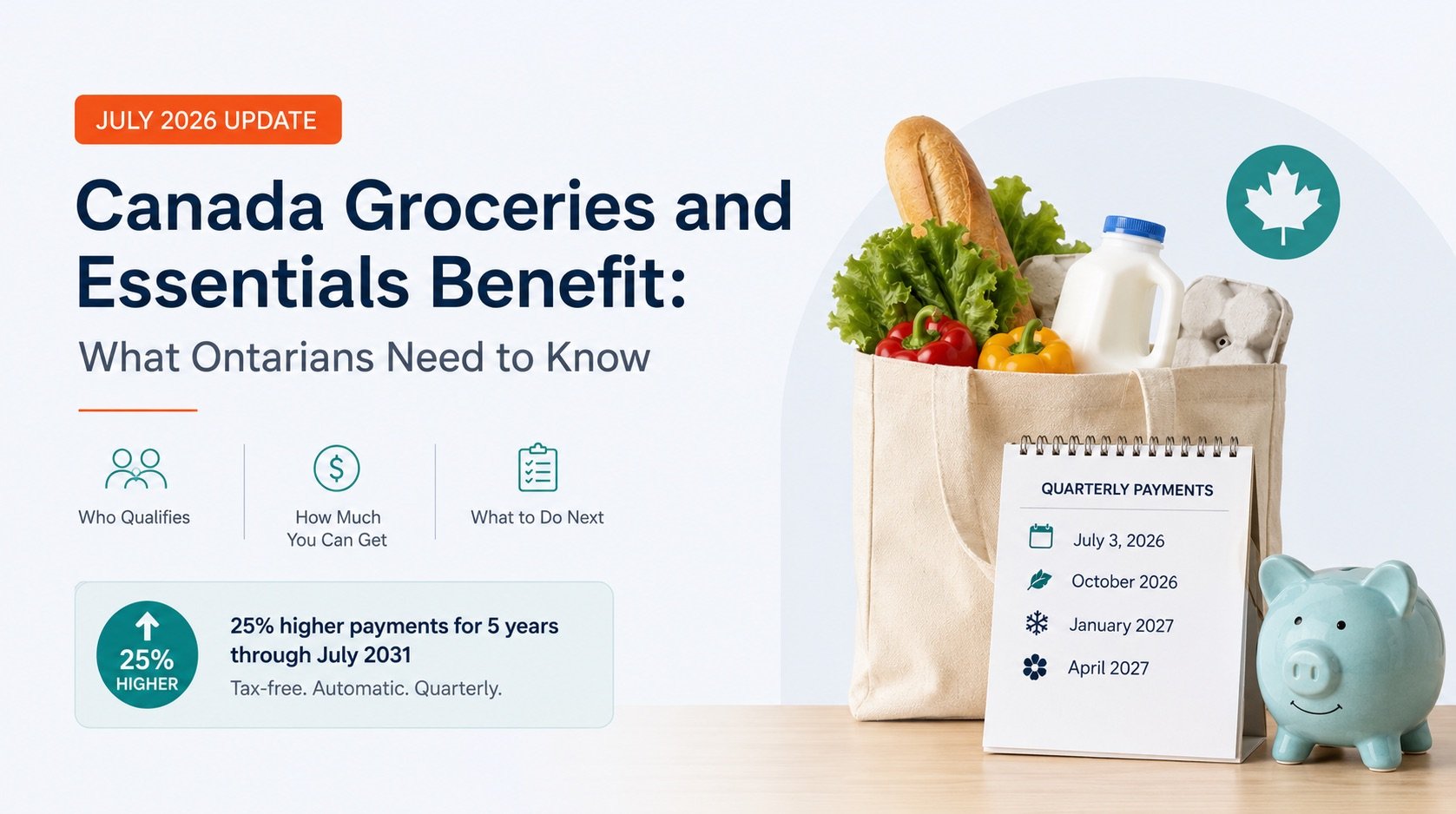
It directly replaces the GST/HST Credit – a benefit that has existed since 1991 – but with one meaningful difference: payments are 25% higher, and that increase is legislated for five consecutive years through July 2031, with annual inflation indexation applied on top.
The structure, eligibility rules, and quarterly payment schedule remain identical to the GST/HST Credit it replaced. If you were already receiving the GST/HST Credit, you are automatically enrolled. No application is required for most recipients.
What Happened in June and July
There were two separate components to this rollout, which has caused some confusion:
June 5, 2026 – One-time top-up payment: Eligible Canadians received a one-time payment equal to 50% of their 2025-26 annual GST/HST Credit entitlement. This was a bridge payment issued as the program formally transitioned. It was based on your 2024 tax return.
July 3, 2026 – First CGEB quarterly payment: This is the start of the ongoing enhanced benefit. Payments are now 25% higher than the equivalent GST/HST Credit would have been. This payment – and all future quarterly payments – is based on your 2025 tax return.
The next quarterly payments will land in October 2026, January 2027, and April 2027.
How Much Can You Receive?
Payment amounts depend on your family situation and adjusted family net income (AFNI). The CRA calculates this automatically from your filed tax return – you don’t need to estimate or apply.
Here are the government’s own published examples for the 2026-27 benefit year, including the June top-up:
Single senior, $25,000 net income: one-time top-up of $267 + ongoing increase of $136 = total increase of $402 for the year. Combined annual CGEB: approximately $950.
Couple with two children, $40,000 net income: one-time top-up of $533 + ongoing increase of $272 = total increase of $805 for the year. Combined annual CGEB: approximately $1,890.
The benefit phases out as income rises – at a rate of 5% for every dollar of adjusted family net income above the phase-out threshold. Higher-income households will receive a reduced benefit or none at all. The exact income cutoffs adjust annually for inflation.
Who Qualifies?
Eligibility mirrors the former GST/HST Credit exactly. To qualify for the ongoing quarterly CGEB payments starting July 2026, you must:
Be a Canadian resident for tax purposes
Be at least 19 years of age (or have a spouse or common-law partner, or be a parent living with your child)
Have filed your 2025 income tax return
Fall within the income eligibility thresholds based on your adjusted family net income
One of the most common reasons eligible Canadians miss out on this benefit is not filing a tax return – particularly low-income individuals who assume they don’t need to file because they owe no tax. Under the CGEB, you must file even if you have zero income. The CRA cannot assess eligibility without a filed return.
What Should You Do Right Now?
If you already received the July 3rd payment: You’re enrolled and no further action is needed. Confirm your direct deposit information is current in CRA My Account to ensure future quarterly payments arrive without delay.
If you didn’t receive a payment on July 3rd and believe you’re eligible: The most likely reason is an unfiled 2025 tax return. Filing now will trigger a reassessment – the CRA will calculate your entitlement and issue any missed payments retroactively once your return is processed. File immediately at canada.ca/taxes or through a CRA-certified tax software.
If you’re a newcomer to Canada: You may need to submit a specific form (RC151 for those without a spouse or child, or RC66 for those with children) rather than relying on the automatic CRA determination. Check canada.ca or contact the CRA directly.
Check your CRA My Account: Your benefit entitlement, payment history, and direct deposit details are all visible there. It’s also where you’ll see if a reassessment is in progress.
A Note on What This Benefit Is – and Isn’t
The CGEB is meaningful support for low- and modest-income Canadians. At $950 annually for an eligible individual or $1,890 for a qualifying family of four, it provides real relief on essential costs.
It’s worth being clear-eyed about what it covers, though. At $237 per quarter for an individual, it offsets some grocery spending – it doesn’t replace a broader financial plan. For most Ontarians, the CGEB is one piece of a larger household budget picture that includes income, debt, savings, and protection planning.
The federal government has also confirmed that the 25% increase is locked in by legislation through 2031, with inflation indexation applied annually on top – so this isn’t a one-year measure. For eligible households, it’s a consistent, predictable income source worth factoring into a household budget going forward.
Other July Benefits Worth Knowing About
The CGEB isn’t the only federal payment landing in Canadian accounts this summer. For context:
Canada Child Benefit (CCB): Indexed upward by CPI for the 2026-27 benefit year, with higher payments beginning July 2026 based on your 2025 tax return. Maximum amounts vary by child’s age and family income.
OAS and CPP: Old Age Security is reviewed quarterly. For July to September 2026, the maximum OAS pension for those aged 65-74 is $707.67 per month, and $899.67 for those 75 and over, subject to income thresholds. CPP amounts vary by contribution history.
Fuel excise tax suspension: The federal government also temporarily reduced fuel excise tax rates to zero cents per litre as of April 20, 2026, through September 7, 2026 – a saving of approximately 10 cents per litre at the pump.
Taken together, July 2026 represents one of the more significant moments for federal affordability measures in recent years. Understanding which benefits you’re entitled to – and making sure you’ve filed your taxes to access them – is the most direct action most Ontarians can take.
The Bigger Financial Picture
Government benefits provide a floor. They aren’t a financial plan. For Ontario households navigating high housing costs, elevated interest rates on debt, and an uncertain economic environment, benefits like the CGEB are valuable – but they work best as a complement to a broader approach that includes building savings, managing debt, and ensuring your family is protected against unexpected events.
If you haven’t reviewed your financial protection recently – including whether your life insurance coverage reflects your current obligations and family situation – mid-summer is as good a time as any.
Get an Instant Quote in Under 2 Minutes → policyfind.ca/get-a-quote
Frequently Asked Questions
Do I need to apply for the Canada Groceries and Essentials Benefit?
Do I need to apply for the Canada Groceries and Essentials Benefit? No – in most cases, eligibility is determined automatically when you file your tax return. If you were already receiving the GST/HST Credit, you are already enrolled. Newcomers to Canada may need to submit a specific CRA form.
What if I didn’t receive the July 3rd payment?
What if I didn’t receive the July 3rd payment? The most likely cause is an unfiled 2025 tax return. File immediately and the CRA will process your entitlement retroactively. You can also contact the CRA at 1-800-959-1953 to confirm your status.
Is the CGEB taxable income?
Is the CGEB taxable income? No. Like the former GST/HST Credit, the Canada Groceries and Essentials Benefit is completely tax-free.
How long will the enhanced payments last?
How long will the enhanced payments last? The 25% increase is legislated through July 2031 – five years – with annual CPI indexation on top. After 2031, the program continues but the legislated increase expires unless renewed.
Does receiving the CGEB affect other benefits I receive?
Does receiving the CGEB affect other benefits I receive? No. The CGEB is paid in addition to other federal benefits including the Canada Child Benefit, the Guaranteed Income Supplement, and the Canada Disability Benefit. It does not reduce or affect eligibility for other programs.
Written by Rajivan Ramachandran, Licensed Advisor at PolicyFind – Lic. #18171391
Rajivan Ramachandran is a licensed life insurance advisor at PolicyFind, helping Canadians navigate life, critical illness, and non-medical insurance solutions across Ontario for over 8 years.
This article is for informational purposes only and does not constitute financial, tax, or legal advice. Benefit amounts, eligibility thresholds, and payment dates are subject to change. Visit canada.ca or contact the CRA directly to confirm your personal entitlement.