
Written by Rajivan Ramachandran
Licensed Advisor at PolicyFind · FSRA Lic. #18171391 · 8+ years advising in Ontario
Today is June 30th – the halfway point of 2026. Half a year has passed, and for most Canadians, the financial intentions set in January are somewhere between “mostly on track” and “I’ll revisit this in the fall.”
This is actually the most useful time to check in. You have six months of real data on where your money has gone, and six months left to course-correct before year-end, when RRSP season, holiday spending, and tax planning all collide at once.
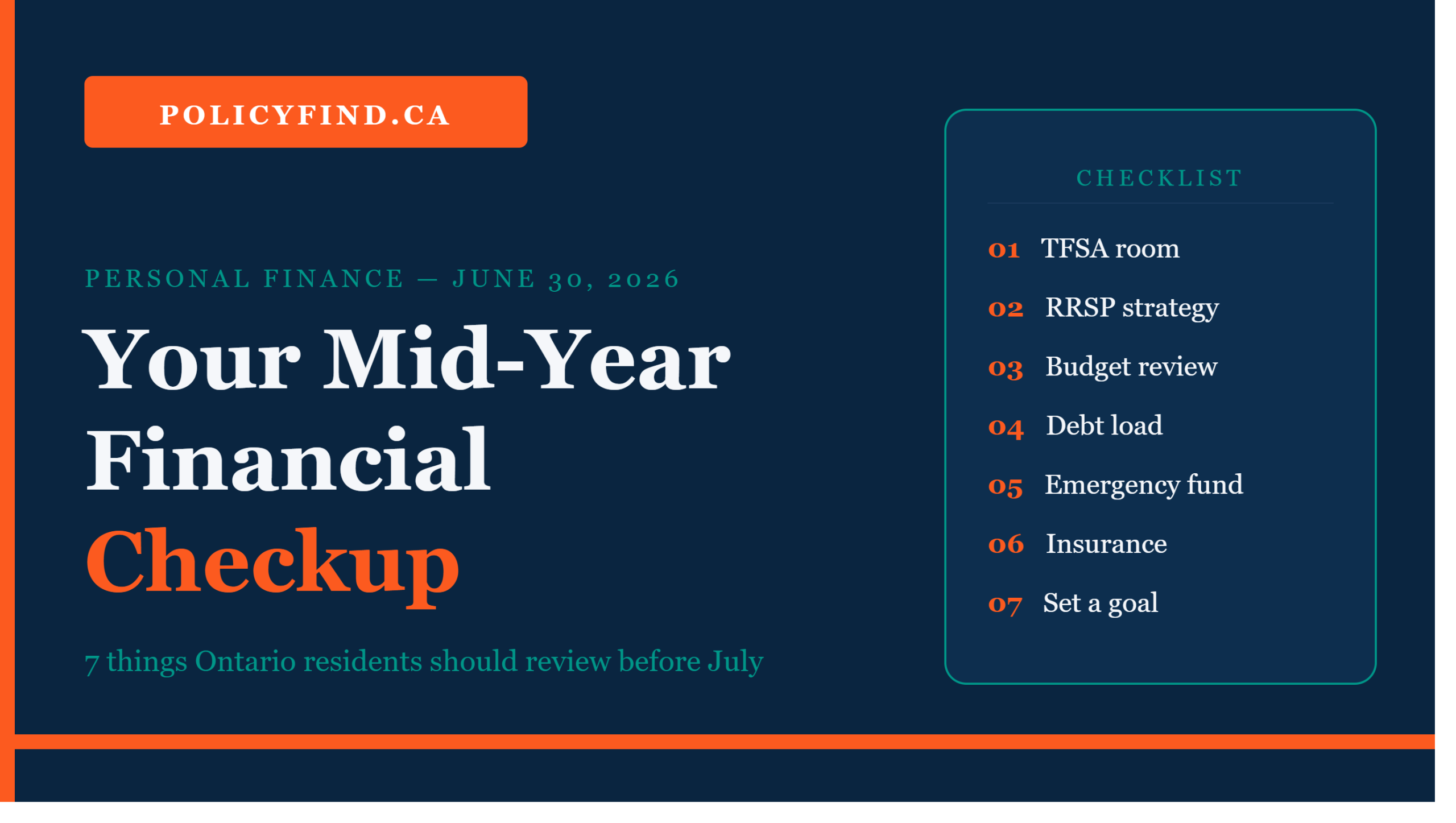
Here’s a practical checklist built specifically for Ontario residents.
1. Check Your TFSA Contribution Room
The TFSA annual contribution limit for 2026 is $7,000, confirmed by the Canada Revenue Agency. If you’ve been eligible since the TFSA was introduced in 2009 and have never contributed, your total available room in 2026 is $102,000.
Mid-year is a good time to check two things: how much you’ve contributed so far in 2026, and whether you have unused room carried over from prior years. Both affect how much you can still put in before December 31st.
A few mechanics worth remembering: any withdrawals you made in 2025 were added back to your contribution room on January 1, 2026. And unlike RRSPs, there’s no annual deadline – you can contribute to a TFSA at any point during the calendar year. Over-contributions, however, trigger a 1% monthly penalty with no grace period, so it’s worth verifying your room through your CRA My Account before making a large deposit.
2. Review Your RRSP Strategy
The 2026 RRSP contribution limit is $33,810, or 18% of your previous year’s earned income – whichever is lower. The deadline for contributions to count toward your 2025 tax return passed in March, but unused room carries forward indefinitely, so this is a good time to understand where you stand heading into 2027 planning.
If your income has increased in 2026, it’s also worth projecting what your 2027 RRSP room will look like, particularly if you’re approaching a bracket where a larger contribution could meaningfully reduce your tax bill next spring.
One nuance for Ontario residents specifically: Ontario has its own provincial tax brackets that interact with federal tax calculations. A financial advisor familiar with Ontario’s tax structure can help you model the combined federal-provincial benefit of a given RRSP contribution – the math isn’t always intuitive.
3. Run a Real Budget Review
Not the one you intended to follow in January. The one reflecting what actually happened.
Pull your last six months of bank and credit card statements and categorize where your money went. Most people find at least one or two categories where spending ran meaningfully higher than planned – subscriptions that renewed quietly, food costs that crept up, or discretionary spending that expanded to fill available income.
With inflation still running in the 2-3% range in Canada through the first half of 2026, and grocery costs remaining elevated, many Ontario households find that their fixed budget assumptions from a year ago are no longer accurate. Revisiting this now gives you the second half of the year to recalibrate.
4. Look at Your Debt Load
The Bank of Canada’s overnight rate is currently 2.25%, held steady through multiple consecutive decisions. Variable-rate debt – including HELOCs, variable mortgages, and certain lines of credit – is priced off this rate. If you’re carrying balances on any of these, mid-year is a useful moment to assess whether accelerated repayment is worth prioritizing.
The broader picture for Canadian households is worth keeping in mind: Canada’s household debt-to-income ratio remains among the highest of any developed nation, sitting near 174%. That’s a national figure, but Ontario – with its higher average property values and cost of living – tends to run above the national average in absolute dollar terms.
If your mortgage is coming up for renewal in the next 12 months, the time to prepare for that is now, not 60 days out.
5. Review Your Emergency Fund
The general guidance is three to six months of essential living expenses held in a liquid, accessible account. For a typical Ontario household spending $5,000-$7,000 per month on essentials, that means $15,000-$42,000 in reserve.
Many households, particularly those who have been directing cash toward RRSP or TFSA contributions or accelerated mortgage repayment, find their emergency fund has been depleted or never fully built in the first place. A high-interest savings account or a liquid TFSA is the right vehicle for this – not invested in equities where a market downturn could hit at exactly the wrong moment.
6. Check Your Insurance Coverage
This is the item most financial checklists skip, and it’s often the most consequential.
Life circumstances change throughout the year. If you’ve had a child, purchased a home, changed jobs, taken on new debt, or seen your income increase since you last reviewed your coverage, your existing life insurance policy may no longer reflect what your family actually needs.
A few questions worth asking at mid-year:
- If something happened to you tomorrow, would your family be able to cover the mortgage, maintain their lifestyle, and fund your children’s education without your income?
- Does your coverage amount reflect your current debt load and dependants, or what they were three or five years ago?
- Are you relying solely on group coverage through your employer – coverage that disappears if you change jobs?
For most Ontario households, the answer to at least one of these questions reveals a gap. A standalone term life policy is typically the most cost-effective way to close it – and getting a quote takes about two minutes.
See Your Rate in Under 2 Minutes → policyfind.ca/get-a-quote
7. Set One Specific Goal for the Second Half of 2026
A mid-year review without a concrete output is just an exercise. Before you close this tab, pick one financial action to complete before December 31st – and make it specific enough to actually track.
Not “save more.” Instead: “max out my remaining TFSA room by November” or “pay down $5,000 on my line of credit” or “review my life insurance coverage and get a quote.”
The most common barrier to financial progress isn’t knowledge – it’s the absence of a specific, time-bound commitment. Half the year remains. That’s more than enough time to make a meaningful move.
The Bigger Picture
The RBC Financial Flexibility Poll from earlier this year found that 49% of Canadians feel optimistic about their personal finances, while 47% feel anxious or exhausted. The divide tracks closely with one variable: whether people feel they have a concrete plan, or whether they’re reacting to financial events as they come.
A mid-year review doesn’t have to be complicated. It’s six months of honest accounting and one or two decisions made with the second half of the year in mind. That’s enough to move from reactive to intentional.
Frequently Asked Questions
What is the TFSA contribution limit for 2026? The 2026 TFSA annual limit is $7,000, confirmed by the Canada Revenue Agency. Total available room for someone eligible since 2009 who has never contributed is $102,000. Unused room carries forward and withdrawals made in 2025 were re-added to your 2026 room on January 1st.
What is the RRSP contribution limit for 2026? The 2026 RRSP limit is $33,810 or 18% of your previous year’s earned income, whichever is lower. The deadline for 2025 tax-year contributions was March 2, 2026. Unused room carries forward indefinitely.
How much should I have in an emergency fund in Ontario? The general benchmark is three to six months of essential expenses in a liquid account. For a typical Ontario household, that’s roughly $15,000-$42,000 depending on your monthly obligations. A high-interest savings account or liquid TFSA is the appropriate vehicle.
When should I review my life insurance coverage? Any major life change – new child, home purchase, income increase, new debt, or job change – is a trigger for a review. Annual check-ins are also reasonable, and a mid-year review is a natural point to do it. Coverage needs change over time and most Canadians underestimate how quickly their situation evolves.
Written by Rajivan Ramachandran, Licensed Advisor at PolicyFind – Lic. #18171391
Rajivan Ramachandran is a licensed life insurance advisor at PolicyFind, helping Canadians navigate life, critical illness, and non-medical insurance solutions across Ontario for over 8 years.
This article is for informational purposes only and does not constitute financial, tax, or insurance advice. Contribution limits, tax implications, and product availability vary by individual circumstance. Speak with a licensed advisor to determine what’s right for your situation.