
Written by Rajivan Ramachandran
Licensed Advisor at PolicyFind · FSRA Lic. #18171391 · 8+ years advising in Ontario
8 min read
Most people assume the Canada Pension Plan will catch a surviving spouse. It does, partly. It just catches far less than almost anyone expects, and the households that planned hardest for retirement are the ones it helps least.
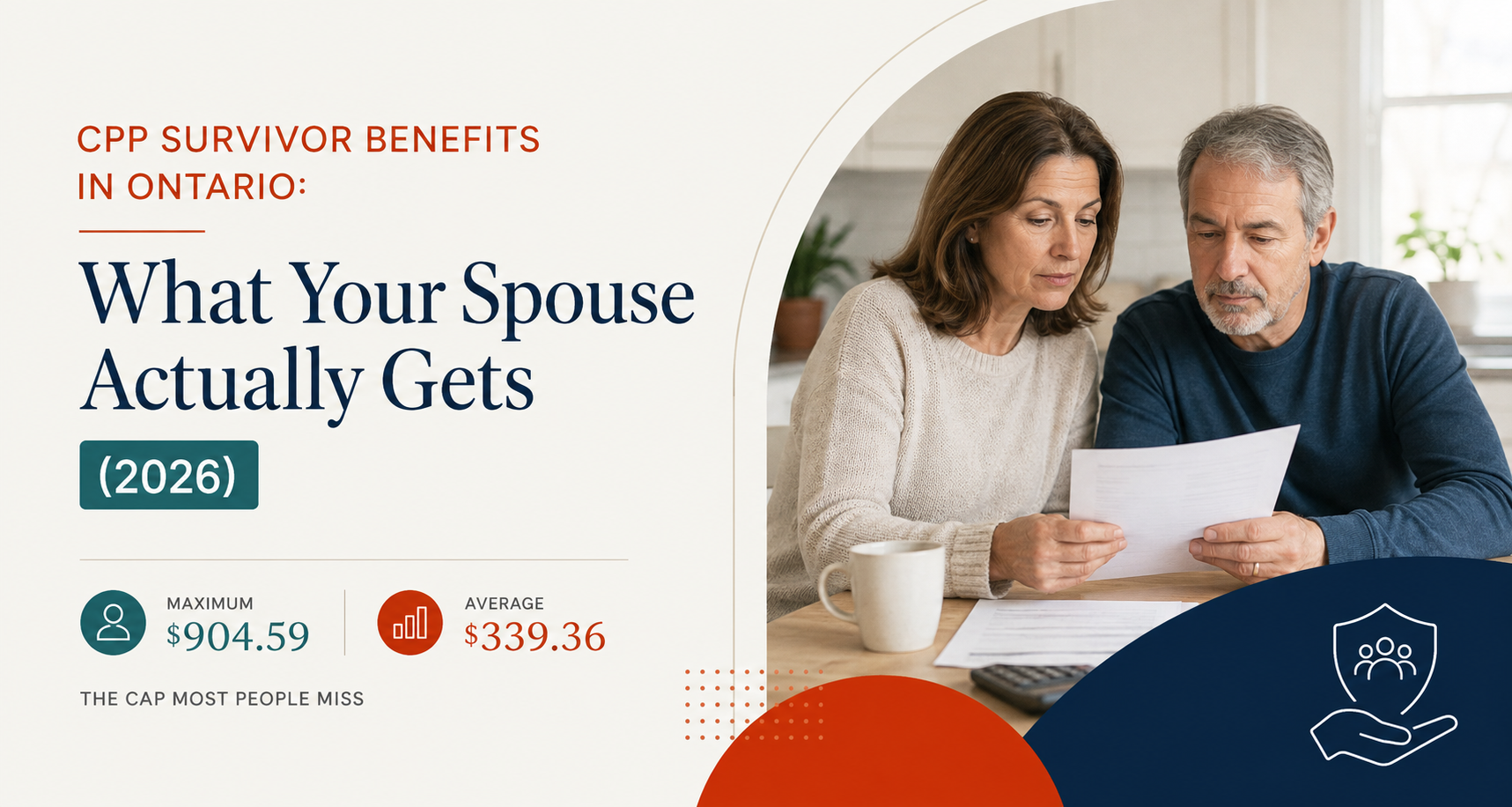
The maximum CPP survivor’s pension in 2026 is $904.59 a month for a survivor aged 65 or older. The average amount actually paid to new beneficiaries in that group is $339.36. That gap is not a rounding error. It is the whole story, and it comes down to two rules almost nobody explains.
What the survivor’s pension actually pays
The survivor’s pension is a monthly payment to the legal spouse or common-law partner of a deceased CPP contributor. How much depends on the survivor’s age and on how much the deceased contributed over their working life.
If you are 65 or older, you receive 60% of the deceased contributor’s retirement pension. If you are under 65, you receive a flat-rate portion plus 37.5% of their retirement pension. Here is what those formulas produce in practice, using Service Canada’s current payment figures for 2026:
| Benefit | Average for new beneficiaries (April 2026) | Maximum (2026) |
|---|---|---|
| Survivor’s pension, under 65 | $549.62 | $803.54 |
| Survivor’s pension, 65 and older | $339.36 | $904.59 |
| Retirement pension at 65, for comparison | $877.01 | $1,507.65 |
| Children’s benefit, under 18 | $307.81 | $307.81 |
The maximum assumes the deceased contributed the maximum amount for essentially their entire career. Very few people do. This is why planning off the maximum is the single most common mistake in this area, and why the realistic number for most Ontario households is closer to the average column than the one beside it.
The rule that surprises people most: you cannot stack two full pensions
If you already receive your own CPP retirement pension, you cannot also collect a full survivor’s pension on top of it. The two are combined into one monthly payment, and that combined amount is capped.
The arithmetic is worth seeing directly. In 2026, the maximum CPP retirement pension is $1,507.65 a month. The maximum combined survivor’s and retirement pension at age 65 is $1,531.56.
That is a difference of $23.91.
In other words, a surviving spouse who already qualifies for the maximum retirement pension gains under $24 a month from their partner’s death, no matter how much that partner contributed over forty years of work. The small increase that does come through exists only because the CPP enhancement component sits outside the cap.
For average earners the picture is better but still modest. The average combined survivor’s and retirement pension is $1,103.97, against an average retirement pension of $877.01. That is a real gain of roughly $227 a month, which is meaningful, but it is nowhere near replacing a departed spouse’s income.
The counterintuitive takeaway: the more successfully you built your own CPP entitlement, the less your spouse’s survivor benefit is worth to you. Dual-income Ontario couples who both worked full careers are precisely the households where this cap bites hardest, and they are also the households most likely to have assumed CPP had them covered.
Is the CPP death benefit really $5,000?
For most married Ontarians, no. It is $2,500.
The death benefit is a one-time payment to the estate of a deceased contributor. Since January 1, 2025, it consists of a basic $2,500 plus a possible top-up of $2,500, for a maximum of $5,000. The $5,000 figure is the one that circulates online.
But the top-up carries two conditions that exclude most couples. To qualify, the deceased must never have received a CPP or QPP retirement, disability, or post-retirement disability pension, and there must be no surviving spouse or common-law partner eligible for a survivor’s pension.
Read that second condition again. If you are married and your spouse qualifies for the survivor’s pension, the top-up does not apply. The top-up exists specifically for contributors who died without a surviving partner and without ever drawing a CPP pension. For a typical Ontario couple, the number is $2,500, and it is taxable in the hands of whoever receives it.
Two and a half thousand dollars does not cover a funeral in Ontario. It was never designed to. It is a contribution toward final costs, not a plan for them.
The deadline that quietly costs people money
Apply immediately. CPP will only back-pay a survivor’s pension for up to 12 months, meaning 11 months plus the month you apply.
The pension itself starts the month after the contributor’s death, and it takes roughly six to 12 weeks to process once Service Canada has a complete application. Neither the survivor’s pension nor the death benefit is issued automatically. Somebody has to apply, and for the death benefit specifically, the executor is expected to apply within 60 days of death.
A grieving spouse who takes eighteen months to get to the paperwork permanently loses six months of payments. This is the most avoidable loss in the entire program, and it happens constantly, because nothing in the system prompts anyone to act.
One more benefit goes almost entirely unclaimed: if you are between 60 and 64, widowed, and have a low income, the Allowance for the Survivor pays up to $1,702.34 a month, tax-free. It is separate from CPP, it is income-tested, and you have to apply for it.
What this means for an actual Ontario household
Run your own numbers rather than the maximums. Log into My Service Canada Account, look at your real CPP statement of contributions, take 60% of that figure, and then check whether the combined cap would erase most of it given your spouse’s own entitlement.
For most couples the honest result is a survivor’s benefit somewhere between $300 and $600 a month, arriving six to twelve weeks after a death, alongside a one-time $2,500 that is spoken for before it lands. Against an Ontario mortgage, that is a rounding error.
This is the specific gap private coverage exists to fill, and it is why the province’s life insurance shortfall matters more than the raw numbers suggest. Unlike CPP, a life insurance death benefit paid to a named beneficiary is received tax-free, is not capped against anything else the survivor receives, and typically pays within weeks rather than months. It is also worth confirming that the beneficiary named on your policy is still the person you intend, since an outdated designation overrides your will regardless of what the will says.
CPP survivor benefits are a floor. They were built as one. The mistake is treating them as a plan.
Get an Instant Quote in Under 2 Minutes → policyfind.ca/get-a-quote
Frequently Asked Questions
Does my spouse automatically receive CPP survivor benefits when I die? No. Both the survivor’s pension and the death benefit require an application. Nothing is issued automatically, and back payments are capped at 12 months.
Can my spouse receive both their own CPP retirement pension and a full survivor’s pension? No. The two are combined into a single payment and capped. In 2026 the maximum combined survivor’s and retirement pension at 65 is $1,531.56, only $23.91 above the maximum retirement pension alone.
Do CPP survivor benefits stop if my spouse remarries? No. The survivor’s pension continues after remarriage. If someone is widowed more than once, only the larger of the two survivor’s pensions is paid.
Are CPP survivor benefits taxable? Yes. The survivor’s pension is taxable income to the survivor, and the death benefit is taxable to whoever receives it, whether that is the estate or an individual.
What if we were separated but never divorced? A separated legal spouse may still qualify if the deceased had no common-law partner. However, a separated spouse whose CPP credit split was approved in January 2025 or later is not eligible for the survivor’s pension from that same contributor.
Written by Rajivan Ramachandran, Licensed Advisor at PolicyFind – Lic. #18171391
Rajivan Ramachandran is a licensed life insurance advisor at PolicyFind, helping Canadians navigate life, critical illness, and non-medical insurance, and plan around retirement and government benefits, across Ontario for over 8 years.
This article is intended for general educational purposes only and does not constitute financial, tax, or legal advice. CPP benefit amounts, eligibility rules, and combined-benefit maximums are set by the federal government and are subject to change; the figures above reflect 2026 amounts published by Service Canada at the time of writing, and individual entitlements depend on contribution history, age, and family circumstances. Confirm your own entitlement through My Service Canada Account, and speak with a licensed advisor about how these benefits fit your household’s overall plan.